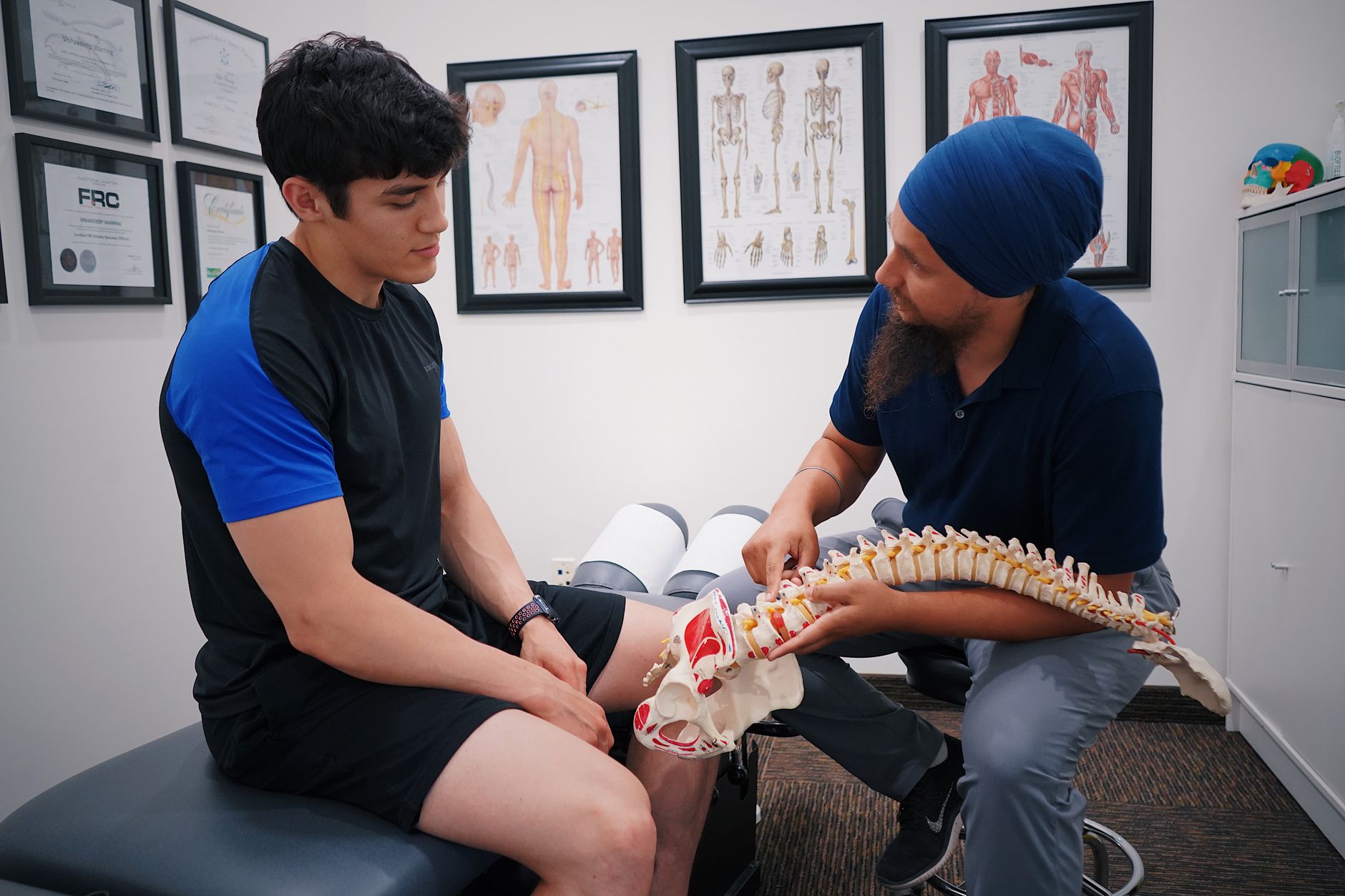
What Is a Herniated Disc? A Plain-English Guide to What's Really Happening in Your Spine
If you've ever been told you have a "slipped disc" or a "bulging disc" and walked away more confused than when you walked in, you're not alone. These terms get thrown around constantly — in doctor's offices, on health websites, even in casual conversation — but very few people actually understand what's happening inside the spine.
As a chiropractor serving patients throughout Bucks County, PA, I've had this conversation hundreds of times. So let's slow down, skip the jargon, and talk about what a herniated disc actually is, why it hurts, and what you can do about it.
---
First, Let's Talk About Your Spine's Architecture
Your spine is made up of 33 vertebrae — the stacked bones that run from the base of your skull down to your tailbone. Between most of those vertebrae sits a structure called an **intervertebral disc**.
Think of each disc like a jelly donut:
- The **outer ring** (called the *annulus fibrosus*) is tough and fibrous — like the dough of the donut. It's built to handle compression, rotation, and bending.
- The **inner core** (called the *nucleus pulposus*) is soft, gel-like, and acts as a shock absorber — like the jelly inside.
These discs do an incredible job. Every time you walk, sit, lift, or twist, they cushion the impact and allow your spine to move fluidly. When they're healthy, you don't think about them at all.
The problem starts when that tough outer ring gets damaged.
---
So What Actually Happens When a Disc Herniates?
A herniated disc occurs when the soft inner material of the disc pushes through a crack or tear in the outer ring. That's it. That's the whole mechanism.
But where it pushes — and what it touches when it gets there — is what determines your symptoms.
Your spine houses the spinal cord and a network of nerve roots that branch out between each vertebra. When herniated disc material bulges backward or to the side, it can **press directly on one of those nerve roots**. That pressure is what causes the pain, numbness, tingling, or weakness you feel.
Here's the key thing most patients don't realize: **the pain you feel in your leg, your foot, or your arm may have nothing to do with that body part itself.** The problem is at the disc level in your spine, and your brain is simply receiving distress signals from the nerve being compressed there.
---
The Difference Between a Bulge, a Herniation, and a Rupture
These terms are often used interchangeably, but they describe different degrees of the same problem:
- **Disc Bulge:** The outer ring is intact, but the disc is pushing outward unevenly — like pressing on one side of that jelly donut without breaking through. This is the mildest form and often responds very well to conservative care.
- **Disc Herniation (Protrusion):** The inner gel has pushed through a weak point in the outer ring but is still contained. This is what most people mean when they say "herniated disc."
- **Disc Extrusion:** The inner material has broken through completely and is now a separate fragment sitting in the spinal canal. This is more serious and may require more aggressive treatment.
- **Sequestered Disc:** A fragment of disc material has broken free and migrated. This is the most severe presentation.
For the majority of patients I see in Morrisville and across Bucks County, we're dealing with bulges and herniations — and the good news is that these respond very well to chiropractic care.
---
Where Do Herniations Most Commonly Occur?
Discs can herniate anywhere along the spine, but the two most common locations are:
The Lower Back (Lumbar Spine) The lumbar discs — particularly **L4-L5 and L5-S1** — bear the most mechanical load in your body. They're under constant pressure from sitting, standing, bending, and lifting. When a lumbar disc herniates, the compressed nerve root often sends pain, tingling, or numbness down through the buttock, into the leg, and sometimes all the way to the foot. You may recognize this as **sciatica** — which I'll cover in detail in a future post.
The Neck (Cervical Spine) Cervical disc herniations — most often at **C5-C6 or C6-C7** — can cause pain that radiates from the neck into the shoulder, arm, and hand. Patients often describe it as a burning, electric, or aching sensation. Grip strength can be affected. Headaches are common.
---
Why Did This Happen to Me?
This is the question I hear most often, and the honest answer is: usually, it's a combination of factors that built up over time.
**Age and degeneration** play a significant role. As we get older, the discs naturally lose water content and become less flexible. That outer ring becomes more brittle and more prone to cracking under stress.
**Repetitive stress** is another major contributor. Years of poor posture, prolonged sitting, repetitive bending, or lifting with poor mechanics gradually wear down the disc's integrity. Many patients are shocked to learn that the "injury" they think happened last Tuesday actually started developing months or years earlier.
**Acute trauma** can also cause a herniation — a car accident, a bad fall, or a sudden heavy lift. But even in these cases, the disc was often already weakened before the event that finally pushed it over the edge.
**Genetics** matter too. Some people simply have disc tissue that is more prone to breakdown than others.
---
What Does a Herniated Disc Feel Like?
Symptoms vary widely depending on which disc is affected and how much nerve compression is occurring. Some people have a herniation visible on MRI and feel almost nothing. Others are in significant pain. Common presentations include:
- **Sharp, shooting pain** that travels down the leg or arm
- **Numbness or tingling** in the extremities
- **Muscle weakness** — difficulty lifting the foot, gripping objects, or climbing stairs
- **Deep, aching pain** in the lower back or neck that worsens with sitting or bending
- **Pain that improves with walking** but returns when you stop
- **Sciatica** — that characteristic pain running from the lower back through the buttock and down the leg
One important note: **not all back pain is disc-related.** Muscle strains, joint dysfunction, sacroiliac problems, and other conditions can produce very similar symptoms. That's why a proper evaluation matters so much before assuming anything.
---
Can a Herniated Disc Heal on Its Own?
Yes — and this surprises many patients. Research shows that herniated discs can and do reabsorb over time. The body recognizes the extruded disc material as foreign tissue and sends immune cells to break it down. This process can take months, but it does happen.
However, "healing on its own" doesn't mean doing nothing. It means:
- Reducing inflammation
- Restoring proper spinal mechanics
- Relieving nerve pressure
- Strengthening the muscles that support the spine
- Modifying activities that aggravate the disc
This is exactly the framework chiropractic care provides.
---
How Chiropractic Care Helps
When a patient comes into our Morrisville office with a suspected herniated disc, my first goal is always to understand the full picture — where the problem is, what's causing it, and what your body needs to recover.
Chiropractic adjustments work by restoring proper alignment and movement to the spinal joints. When the vertebrae above and below a herniated disc are moving correctly, it reduces abnormal pressure on the disc itself. Improved joint mechanics also reduce the muscle guarding and spasm that often make disc pain worse.
Depending on the severity and location of the herniation, I may also incorporate:
- **Flexion-distraction technique** — a gentle, non-thrusting method that creates a pumping motion to reduce disc pressure and encourage the nucleus to retract away from the nerve
- **Soft tissue therapy** to release tight muscles contributing to nerve compression
- **Rehabilitative exercises** to build the core stability that protects the disc long-term
- **Postural correction** to address the underlying mechanics that contributed to the herniation
- **Lifestyle guidance** on ergonomics, sleep position, and activity modification
For many patients, chiropractic care provides significant relief without surgery or long-term medication dependence.
---
When Is Surgery Necessary?
I want to be straightforward with you: most herniated discs do **not** require surgery. Studies consistently show that the majority of patients with lumbar disc herniations improve significantly with conservative care within 6 to 12 weeks.
Surgery becomes a more serious consideration when:
- There is progressive neurological loss (rapidly worsening weakness or loss of bladder/bowel control)
- Conservative care has been tried diligently for an appropriate period without improvement
- Imaging and clinical findings clearly indicate a structural problem that cannot resolve otherwise
If I ever believe a patient needs a surgical consultation, I will say so directly and make the appropriate referral. My job is to get you better — not to keep you coming in indefinitely.
---
What You Should Do If You Think You Have a Herniated Disc
If you're experiencing back pain, neck pain, or radiating symptoms into your arms or legs, here's my honest advice:
1. **Don't ignore it.** Early intervention almost always leads to faster, more complete recovery.
2. **Don't self-diagnose from the internet.** Similar symptoms can have very different causes.
3. **Get a proper evaluation.** A thorough clinical exam — and imaging if warranted — will tell us what's actually going on.
4. **Be patient with the process.** Disc injuries take time to heal. Consistency with care and home recommendations matters.
Our office in Morrisville is here to help patients throughout Bucks County understand what's happening in their bodies and make confident decisions about their care. You deserve clear answers, not more confusion.
---
Schedule Your Evaluation Today
If you've been dealing with back pain, neck pain, or symptoms that sound like what we've described here, I'd like to meet with you. We'll take the time to listen, examine, and explain — so you leave with a real understanding of your condition and a clear path forward.
📍 Serving Morrisville, PA and all of Bucks County
📞 Call our office or visit [fairlesshillschiropractor.com](https://fairlesshillschiropractor.com/) to request an appointment.
*— Dr. Tony Gardner, Chiropractor | Fairless Hills & Morrisville, PA*
---
*This blog post is intended for educational purposes and does not constitute medical advice. Please consult a qualified healthcare provider for diagnosis and treatment of any medical condition.*
